
Episode 5 Wine Notes
Sherry
Jerez is a Spanish city and municipality in the province of Cádiz in southwestern Spain, situated midway between the Atlantic Ocean and the Cádiz Mountains.
Bodegas Barbadillo was founded in 1821 by Don Benigno and Don Manuel Barbadillo in Sanlucar de Barrameda and still under family control today this is one of the largest and most established Sherry Bodegas.
In the solera process, a succession of containers are filled with the product over a series of equal aging intervals (usually a year). A group of one or more containers, called scales, criaderas (‘nurseries’), or clases are filled for each interval. At the end of the interval after the last scale is filled, the oldest scale in the solera is tapped for part of its content, which is bottled. Then that scale is refilled from the next oldest scale, and that one in succession from the second-oldest, down to the youngest scale, which is refilled with new product. This procedure is repeated at the end of each aging interval. The transferred product mixes with the older product in the next barrel.
Manzanilla – Sanlucar de Barrameda
The special microclimatic conditions in the bodegas located in the coastal town of Sanlucar de Barrameda produce a very distinctive kind of “flor”. This very special kind of biological ageing confers unique characteristics to the wines. Indeed they are so special and are produced in such a well-defined area that they have their own Denomination of Origin, that of “Manzanilla – Sanlucar de Barrameda”.
Manzanilla’a are straw-coloured wines with a dry, sharp bouquet which is light and often salty on the palate. It is exclusively aged under “flor” in Sanlucar de Barrameda. Its alcohol content varies from 15º to 19º. Although the definitive Manzanilla is the so-called Manzanilla-Fina, an extremely pale, light , dry wine, depending on the length and circumstances surrounding its ageing process, there are other types of Manzanilla. Among these, special mention must be made of Manzanilla pasada which is less pale and has more body due to a slight oxidation of the wine during its very long ageing process.
Fino – Straw-coloured or golden, finos have a spicy, delicate aroma reminiscent of almonds, and are dry and light in the mouth. Their special properties are the result of the exclusive ageing process under the veil of flor. The very dry finish of Fino is due to the consumption of glycerol by the flor. They have an acquired alcohol content of 15º -18o. Fino are best served cold.
Amontillado – The ageing process used in these wines includes an initial phase under the veil of flor – similar in procedure and duration to that undergone by finos – followed by a phase of oxidative ageing. The result is an amber-coloured wine with aromas of hazelnut, mildly tangy, soft and full in the mouth, with an alcohol content of between 16º and 22º.
Oloroso – An initially dry wine, from amber to mahogany in colour, with a strong aroma reminiscent of walnuts, full-bodied, with an alcohol content of between 17º and 22º. Ageing begins under the veil of flor, then continues with a phase of oxidative ageing. Ideal as an aperitif, as well as with game and red meats.
Palo Cortado – A bright mahogany-coloured wine, with a bouquet suggestive of hazelnuts and a dry palate. Palo Cortado is a special style that results from an early transition from development under flor to oxidative development. This used to occur when the flor failed to develop at an early stage; now it is more a matter of selection on the basis of the organoleptic qualities of the wine. After a few months development under flor, it is fortified to 18-20% cent alcohol, and develops into a halfway house between Amontillado and Oloroso. The decision is made at the second classification. A Palo Cortado is recognized by an aroma similar to Amontillado, but the body associated with Oloroso. One theory is that these wines occur when an unusually high content of malic acid leads to a malolactic fermentation; this could explain the lactic quality that is associated with the style. Its alcohol content varies between 17º and 22º.
Pedro Ximenez – This style of Sherry offers one of the great sweet wines of the world. A dark, mahogany-coloured wine with a deep bouquet of raisins and mollasses, it is a smooth, highly viscous and sweet style. Pedro Ximenez Sherry is a perfect match with chocolate, and is also consumed over ice in the warmer weather.
Some to try
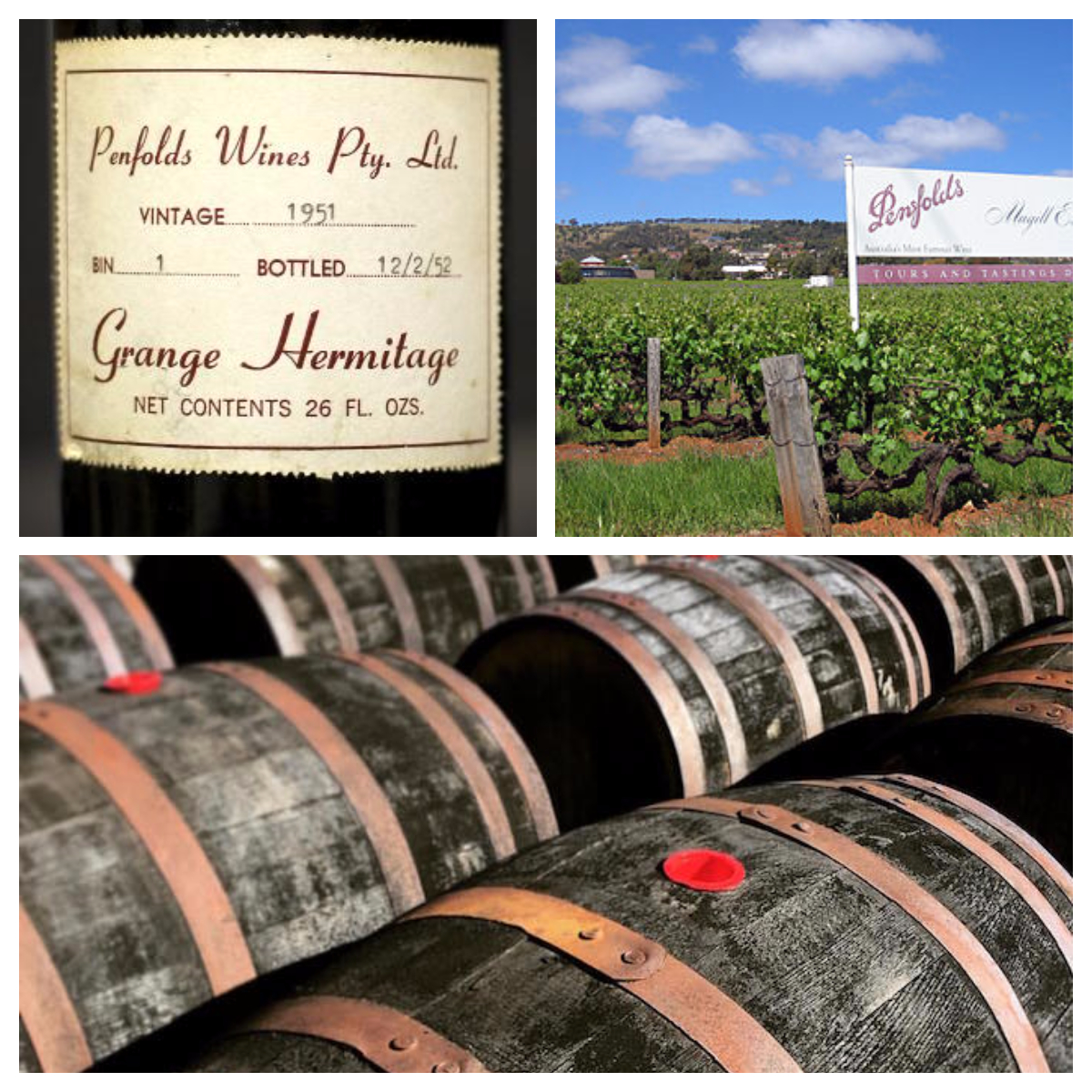
5. Wine Rack of the Gods – Penfolds Grange 1951
Penfolds is an Australian wine producer that was founded in Adelaide in 1844 by Christopher Rawson Penfold, an English physician who emigrated to Australia, and his wife Mary Penfold.
It is one of Australia’s oldest wineries, and is currently part of Treasury Wine Estates.
The 1951 Penfolds Grange Hermitage is known to have only about 20 other bottles left in existence today. In May of 2004, a wine collector in Adelaide paid AUS$50,200 for a bottle at an Australian auction house.
In June 2012 Penfolds released a limited edition run of the “2004 Block 42” wine that was only sold in glass ampoules. The wine was labelled by the Huffington Post publication as “the most expensive wine directly sold from a winery in the world”, as the winery sought US$168,000 for each of the ampoules. The glass ampoules were designed and hand-blown by Australian glass artist Nick Mount.
1951 was the first year that Grange was produced. It was an experiment, then-winemaker Max Schubert’s attempt to create a great Australian wine to challenge Bordeaux’s first growths. It was mostly Shiraz with a very small splash of cabernet sauvignon. They tried to sell the 1952. It wasn’t an immediate success; one doctor suggested it would make a good anaesthetic!
Yet time proved out his experiment. Sixty-plus years later, Grange is in huge demand, especially in China.

 The Food Group